
 English
 Magyar
 Polski
A short journey back in time before we set off
Eger’s history spans many centuries, and the city we see today is shaped by the traces of many different eras living side by side. But if we want to discover Eger’s Ottoman heritage, we need to travel back to the 16th century.
In 1552, Eger became known across Europe for its famous defence against the Ottoman armies. But the story did not end there. In 1596, the Ottoman Empire captured the city, and Eger remained under Ottoman rule for 91 years. The city was finally liberated on 17 December 1687.
Almost a century of Ottoman rule naturally left its mark on Eger. During this period, the city was not only an important fortress on the frontier, but also became an important centre of Ottoman administration and culture. Mosques, minarets, baths and other buildings appeared, giving the city a completely different character.
Then history took another turn. After the Ottomans left, Eger gradually changed once again. Some buildings disappeared, others were rebuilt or given new purposes, while in some cases only archaeological remains survived.
Yet part of Ottoman Eger is still with us today – sometimes clearly visible, and sometimes hidden beneath the layers of the city.
And perhaps that is exactly what makes this journey so fascinating.
We are not only going to visit the places that still stand today, but also discover those whose traces are all that remain. We will see what survived from the former Ottoman buildings, what archaeologists uncovered centuries later, and along the way, we will try to imagine the Eger of four hundred years ago – a city filled with very different sounds, buildings and people.
Join us and discover Eger’s Ottoman heritage together – starting from Merlot Hotel!
🗺️ Our route
We have designed the route so that it can be comfortably explored on foot. On the map, we have marked not only the Ottoman heritage sites that can still be seen today, but also places that have disappeared and were once an important part of life in Ottoman Eger.
🏨 Starting from Merlot Hotel
After enjoying a delicious buffet breakfast, it is time to set off!
Today, we are going to explore Eger’s Ottoman heritage, and luckily, our first stop is not far away.
Leaving Merlot Hotel, we make our way towards the ruins of the Valide Sultan’s Bath. It is a particularly fitting place to begin our walk: rather than visiting a monumental building, we are starting with a fascinating reminder of the past whose story is made even more intriguing by the fact that only its excavated remains can be seen today!
🛁 Stop 1 – The ruins of the Valide Sultan’s Bath
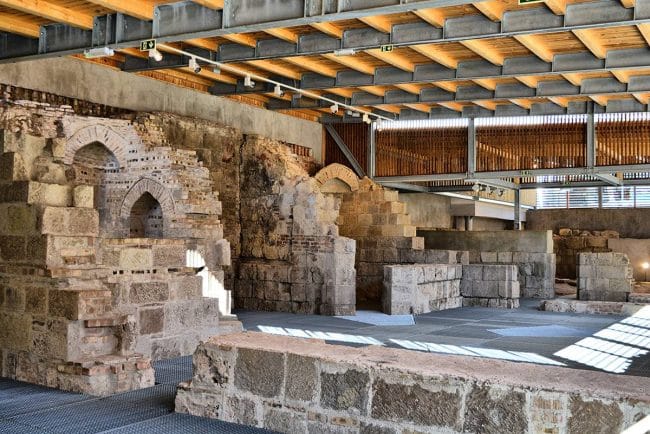
The bath was built during the Ottoman period and was once a hammam, a traditional Turkish bath. Thanks to archaeological excavations, we now know much more about it than the remaining walls might reveal at first glance.
📖 But what exactly is a hammam?
A hammam is a traditional Turkish bath. Bathing was about much more than simply washing: it was also an important place for relaxation, socialising and community life.
Archaeological excavations have revealed that the former bath consisted of several sections. Researchers identified, among other features, the entrance hall, the heating system beneath the floor, the cold- and hot-water systems, as well as traces of its former rooms.
What we see today is therefore only a fragment of what once stood here – yet it still tells us surprisingly much about Ottoman bathing culture.
👑 What does Valide Sultan mean?
Valide Sultan is not the name of a particular person. It was a title given in the Ottoman Empire to the mother of the reigning sultan. Women who held the title could have considerable influence within the imperial court.
Even the name itself offers us a small glimpse into the world in which Eger existed under Ottoman rule.
🏰 Stop 2 – Back to the Castle
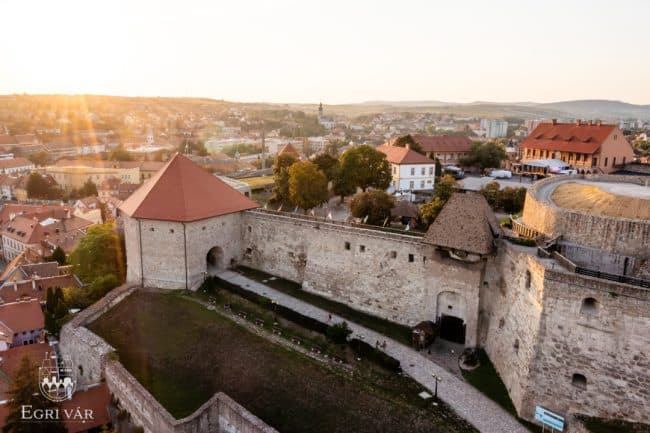
From the bath ruins, we continue towards one of Eger’s best-known landmarks: Eger Castle.
Before we start looking for traces of Ottoman Eger, however, it is worth taking a moment to look back at three defining years in the castle’s history.
⚔️ 1552 – Eger stops the Ottoman army
In 1552, the Ottoman army laid siege to Eger Castle. Under the leadership of István Dobó, the castle defenders resisted the vastly larger Ottoman force for weeks, eventually forcing the besieging army to withdraw.
The defence of Eger Castle became one of the city’s greatest sources of historical pride, and the story became known to generations through Géza Gárdonyi’s famous novel The Stars of Eger (Egri csillagok).
🕌 1596 – Eger falls to the Ottomans
But the story did not end in 1552.
In 1596, the Ottoman army captured Eger Castle.
A new era began: Eger became part of the Ottoman Empire for 91 years. The city developed into an important military and administrative centre, and this was when the mosques, minarets and baths whose traces we are following on our walk began to appear.
🕊️ 1687 – The Ottoman era comes to an end
In 1687, Christian forces recaptured Eger Castle, bringing almost a century of Ottoman rule in the city to an end.
After the Ottomans left, the city changed once again. Former buildings disappeared, others were rebuilt or given new purposes, and many traces of the Ottoman era gradually faded away.
Walking among the walls of Eger Castle, we can therefore encounter the memories of three major turning points in the city’s history: the heroic defence of 1552, the Ottoman conquest of 1596, and the liberation of 1687.
🕌 Stop 3 – Eger Minaret
After visiting the castle, let us continue towards the city centre, where one of Eger’s most distinctive Ottoman landmarks awaits us: Eger Minaret.
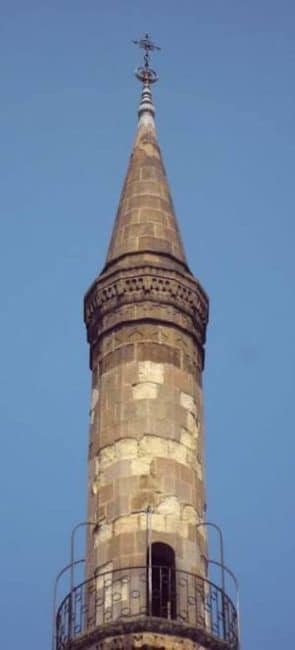
Today, the slender tower is almost inseparable from Eger’s skyline. When it was built, however, it served a very different purpose. It belonged to the Kethuda Mosque, and from here the muezzin called the faithful to prayer five times a day.
📖 But what exactly is a minaret?
A minaret is a tower associated with Islamic religious buildings, particularly mosques. The muezzin traditionally called the community to prayer from the minaret.
🕌 And what is a mosque?
A mosque is a place of worship in Islam. Larger mosques served as important places for communal prayer.
During the Ottoman period, several mosques stood in Eger. The Kethuda M
osque once stood beside the Minaret, but it is no longer visible today. The mosque was demolished in 1841, leaving the Minaret as the most important surviving part of the former complex.
🌙 A tower that has witnessed centuries of change
The Minaret survived the end of the Ottoman period and the centuries that followed.
Today, a Christian cross rises towards the sky from the top of the tower, creating a remarkable reminder of the passage of time and the changes Eger has witnessed.
A tower once filled with the voice of the muezzin now stands above the city as one of Eger’s most recognisable landmarks.
🏃 4. Following the footsteps of The Stars of Eger
Before reaching Dobó Square, it is worth taking a little detour towards Gárdonyi Square and the Square of the Valiant Soldiers.
On Gárdonyi Square, we are welcomed by a statue of Géza Gárdonyi – the writer whose novel The Stars of Eger made the story of the defenders of 1552 immortal for generations of readers.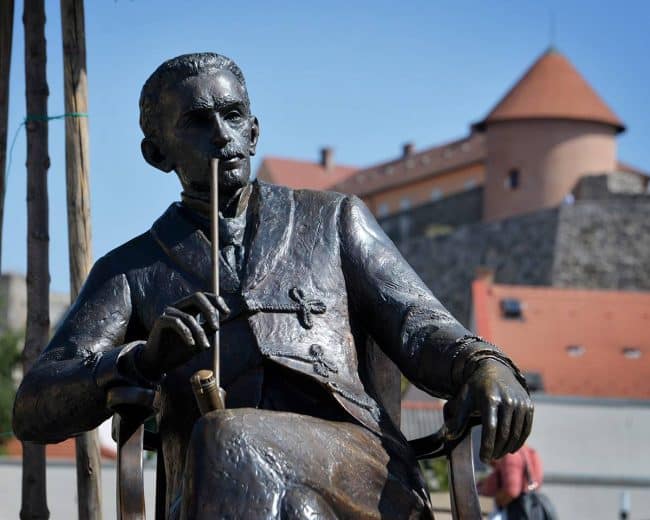
5. Square of the Valiant Soldiers
From here, it is only a short walk to the Square of the Valiant Soldiers, where the statues depicting children offer us a very different way of connecting with the story of Eger’s frontier fortress.
Perhaps this is the perfect place to pause for a moment and imagine what it might have been like to be a child in a city whose walls were under siege.
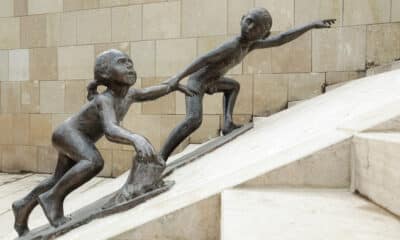
From here, it is truly only a few steps to Dobó Square, where a statue of István Dobó awaits us.
🏛️ 6. Dobó Square
Continuing from Gárdonyi Square, we soon arrive in the heart of Eger: Dobó Square.
The name may sound familiar. The square was named after István Dobó, the legendary captain of Eger Castle during the 1552 siege. His statue stands in the centre of the square today.
It is worth taking a moment here to think back to the story we encountered at the castle: in 1552, Dobó defended Eger against the Ottoman army. Just a few decades later, however, Eger had become part of the Ottoman Empire.
This small detour beautifully illustrates how closely the Hungarian and Ottoman chapters of Eger’s history are intertwined.
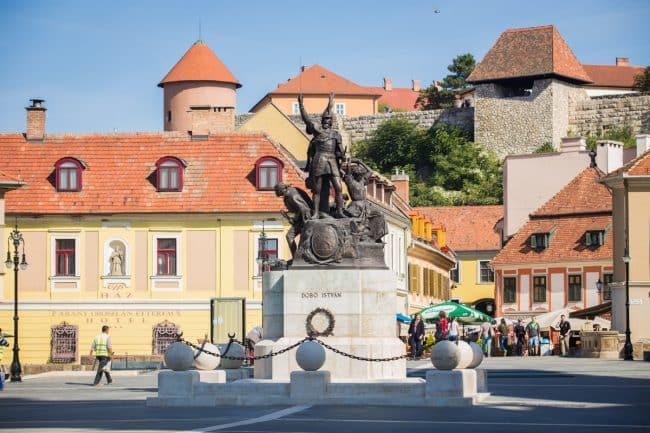
♨️ 7. Stop – A well-deserved ending to our journey: Turkish Bath
After exploring Ottoman culture and history, we may well have earned a little rest.
At the end of our journey, a truly special experience awaits: Eger’s Turkish Bath, where we can relax in the pleasantly warm thermal waters.
The bath’s history stretches back several centuries, so we are not simply ending our day with a relaxing swim – we are stepping into a living part of the city’s Ottoman bathing heritage.
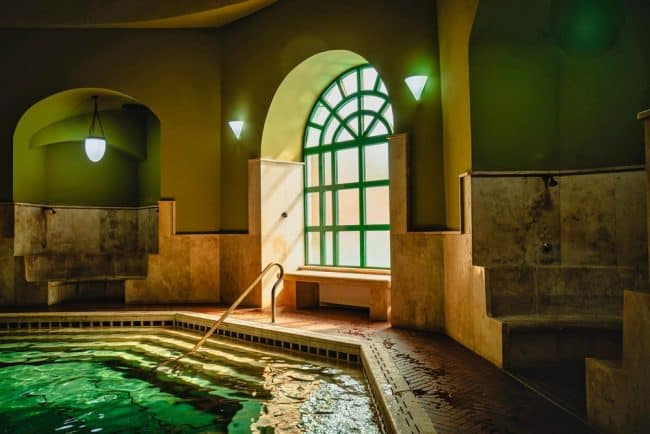
♨️ But what exactly is a hammam?
A hammam is a traditional Turkish bath. In Ottoman culture, bathing was not simply about cleanliness; it was also an important part of relaxation, social life and community.
There may be no better way to end a journey through Eger’s Ottoman past than with a relaxing bath in the city’s warm thermal waters.
In the morning, we set out to search for traces of history. Now, after a relaxing bath, perhaps we can look at the city with slightly different eyes.
Because in Eger, the past is not always hidden in museums or behind old walls – sometimes it is simply there in front of us, or even in the warm waters of a thermal bath. ❤️
🔎 What we can no longer see – only imagine
Walking through Eger today, it can sometimes be difficult to imagine that the same streets and squares were once filled with very different buildings, sounds and lives.
During the 91 years of Ottoman rule, Eger’s cityscape changed considerably. Mosques, minarets, baths and other buildings connected to Ottoman culture appeared throughout the city. After the Ottomans left, however, many of them disappeared: they were demolished, rebuilt, incorporated into other structures, or simply vanished over the centuries.
Today, we can often discover where they once stood only through archaeological excavations, historical descriptions and research.
So at this point, let us put aside what we can see with our own eyes for a moment.
Let us explore what is no longer standing before us – but what history allows us to imagine.
🕌 Eger, where several minarets once rose above the city
When we think of Eger’s Ottoman heritage today, most of us immediately think of Eger Minaret. Yet during the Ottoman period, it was not the city’s only minaret.
In Ottoman Eger, several mosques and their accompanying minarets were once in use. The muezzin’s call to prayer could be heard five times a day, calling the Muslim community to prayer.
Try to imagine it:
We are walking through the streets of today’s city centre, but instead of the familiar skyline, we see the slender towers of several minarets rising above the rooftops, while the call to prayer echoes through the city.
Today, only Eger Minaret remains as a reminder of that skyline.
🕌 Kethuda Mosque – whose companion has disappeared
The Kethuda Mosque once stood beside Eger Minaret. The mosque was a place for communal prayer, while the minaret beside it served as the place from which the faithful were called to prayer.
The mosque itself is gone. It was demolished in 1841, so when we stand beside the Minaret today, we are looking at the surviving part of a former architectural complex – a tower standing where an entire place of worship once stood.
Perhaps that is why it is worth stopping for a few seconds at the foot of the Minaret.
Look up at the tower and imagine that it is not standing alone.
The mosque is there beside it, while people from the city move around its entrance. The muezzin’s call to prayer fills the surroundings, and for a moment, a completely different Eger comes to life around the Minaret.
🛁 And the Valide Sultan’s Bath is not the only trace left behind
The traces of Ottoman bathing culture were once far more prominent than what we can see in Eger’s cityscape today.
The ruins of the Valide Sultan’s Bath are particularly fascinating because we do not know about the bath only from written descriptions: the remains of the actual building were uncovered through archaeological excavation and made accessible to visitors.
The former Ottoman bath later lost its original function. According to local historical documentation, it ceased to be used as a bath by the late 17th century and was later used for other purposes, including as a grain store.
A bath that was once part of everyday life in Ottoman Eger no longer stands before us as a functioning building. Archaeology, however, has returned a small part of it to the city.
🪨 Perhaps the most fascinating things are the ones hidden beneath the ground
Research shows that Ottoman Eger was home to far more than we can see today: mosques, minarets, baths and other buildings were all part of the cityscape.
However, based on the surviving sources, we can no longer determine with certainty in every case exactly where these buildings stood, what they looked like or what remains of them.
And perhaps that is what makes a journey like this so fascinating:
We do not always search for what is still standing. Sometimes, we also search for what can now live only in our imagination.